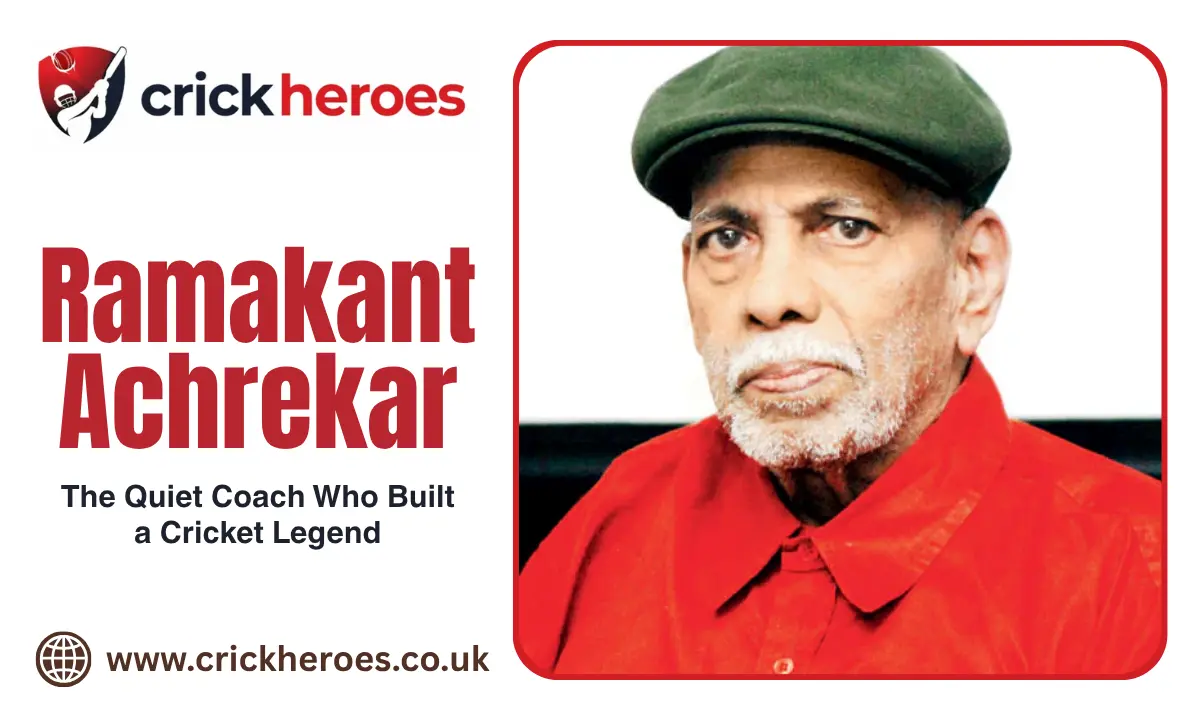
When people talk about Indian cricket’s golden generation, names like Sachin Tendulkar, Vinod Kambli, and Ajit Agarkar come up instantly. But behind almost all of them stood one quiet, disciplined figure who rarely sought the spotlight — Ramakant Vitthal Achrekar.
Known to everyone simply as “Achrekar Sir,” he was far more than a cricket coach. He was a talent scout, a disciplinarian, and a mentor who turned ordinary schoolboys from Mumbai’s maidans into some of India’s finest cricketers.
Who Was Ramakant Achrekar?
Ramakant Vitthal Achrekar was born in 1932 in Malvan, then part of the Bombay Presidency in British India. His own playing career was modest. But his impact as a coach earned him a place among India’s most respected sporting figures.
| Personal Details | Information |
|---|---|
| Full Name | Ramakant Vitthal Achrekar |
| Year of Birth | 1932 |
| Place of Birth | Malvan, Bombay Presidency, British India |
| Profession | Cricket coach; Mumbai cricket selector |
| Famous For | Coaching Sachin Tendulkar and Amol Muzumdar, among others |
| Awards | Dronacharya Award (1991), Padma Shri (2010) |
| Date of Death | 2 January 2019 |
| Age at Death | 87 |
He played only one first-class match in his career. Yet he proved that greatness in sport isn’t limited to those who make the headlines.
Early Life and Cricket Journey
Achrekar’s own cricketing journey began in the 1940s.
He started playing in 1943 and joined New Hind Sports Club for club cricket in 1945. His only first-class appearance came for All-India State Bank against Hyderabad, in the 1963–64 Moin-ud-Dowla tournament.
He never made a name as a player. But his sharp eye for technique and temperament made him a natural coach.
Shivaji Park in Dadar became his real classroom. Generations of young cricketers passed through his nets there over the decades. He also went on to serve as a selector for the Mumbai cricket team.
The Sachin Tendulkar Connection
No account of Achrekar’s life is complete without Sachin Tendulkar — the pupil who became the highest run-scorer in Test and ODI cricket history.
How the Trial Went
It was Sachin’s elder brother, Ajit, who first brought him to Achrekar’s summer camp at Shivaji Park.
The first trial did not go well. Young Sachin had never faced these nets before and felt overawed by the crowd. Under Achrekar’s direct gaze, he failed to impress.
Achrekar told Ajit that Sachin was perhaps too young for the camp.
The Second Chance
Ajit pushed back. He explained his brother was simply nervous, and asked for one more trial half an hour later — this time with Achrekar watching quietly from a distance.
Achrekar agreed. Freed from direct pressure, Sachin batted the way he actually could. Achrekar saw his natural talent immediately and admitted him into the camp.
He soon advised the family to move Sachin from Bandra’s New English School to Dadar’s Sharadashram Vidyamandir, a school with a far stronger cricketing culture. That single decision opened the door to better competition and, eventually, to the Indian team.
The Famous One-Rupee Coin Story
One story stands above the rest in Achrekar folklore.
During long practice sessions, he would place a one-rupee coin on top of the stumps. Any bowler who dismissed Tendulkar won the coin. If Tendulkar batted through the whole session unbeaten, the coin was his.
He won thirteen such coins. Tendulkar has often called them among his most treasured possessions.
The drill was simple, but it taught concentration and the value of guarding one’s wicket — habits that defined his batting for 24 years at the top level.
Coaching Philosophy: Discipline Above Everything
Achrekar’s method was built on a few consistent principles, not complex theory. In a 1998 interview, he summed up his approach:
“I take a thorough trial of each student, and observe his technique and style. Every player should stick to his natural game, not change it, but improve it through practice.”
His core principles, as remembered by his students, came down to a handful of simple rules:
- Practise every single day, without exception
- Respect the game more than personal milestones
- Never look for shortcuts to success
- Let performance on the field do the talking
- Stay humble no matter how much success comes
The School Match Incident
Achrekar was famously strict. Once, a young Tendulkar skipped batting for his school’s ‘B’ team and sat in the stands cheering for his friends instead.
That evening, Achrekar asked him how many runs he’d scored. Tendulkar admitted he’d only been cheering.
The reaction was sharp, and the lesson stuck for life: play in a way that gets you cheered for — don’t sit and cheer for others.
Notable Players Coached by Achrekar
Sachin Tendulkar remains his most famous student. But calling Achrekar just “Tendulkar’s coach” undersells his real impact.
Over five decades at Shivaji Park’s Kamath Memorial Cricket Club, he shaped a long line of India and Mumbai players, including:
- Vinod Kambli – Former India batsman, known for his record school partnership with Tendulkar
- Ajit Agarkar – Former India fast bowler and all-rounder
- Chandrakant Pandit – Former India wicketkeeper-batsman, later a successful domestic coach
- Pravin Amre – Former India batsman, later a respected national-level coach
- Ramesh Powar – Former India off-spinner
- Amol Muzumdar – One of the most prolific run-scorers in Indian domestic cricket history
- Sameer Dighe – Former India wicketkeeper
- Balwinder Singh Sandhu – Former India seamer, remembered for dismissing Gordon Greenidge in the 1983 World Cup final
This roster is the real measure of his legacy — not one genius produced by chance, but an entire pipeline of players built over generations.
Awards and Recognition
Achrekar’s contribution to Indian sport was formally recognised at the national level.
Dronacharya Award (1991)
India’s highest official honour for a sports coach, awarded for his services to cricket coaching.
Padma Shri (2010)
India’s fourth-highest civilian award, conferred on him in the sports category.
For a coach who worked mostly at the club level, these honours were a rare official nod to a legacy that had, until then, spread mainly by word of mouth.
Later Years and Passing
Achrekar remained a familiar, if increasingly frail, presence at Mumbai cricket events well into his eighties.
At the launch of a corporate cricket tournament, an 80-year-old Achrekar — needing help to communicate — summed up his feelings about his star pupil in four words: “There is no one like Sachin.”
He passed away at his home in Mumbai on 2 January 2019, at the age of 87, after battling age-related ailments. His family confirmed the news that same evening.
Tributes poured in from across the cricketing world. Tendulkar’s was the most personal, calling Achrekar his lifelong mentor and saying cricket in heaven would be enriched by his presence.
A Lasting Tribute at Shivaji Park
Achrekar’s story didn’t end with his passing.
In December 2024, Sachin Tendulkar unveiled a memorial dedicated to his late coach at Shivaji Park — the very ground where Achrekar spent decades spotting young talent.
Speaking at the unveiling, Tendulkar described him as an “all-rounder” whose coaching went far beyond the field. The event, attended by MNS chief Raj Thackeray among others, showed that five years on, Achrekar’s presence is still woven into Mumbai cricket’s identity.
Lesser-Known Facts
- Played only one first-class match in his entire career
- Coached at Shivaji Park for several decades
- Also worked as a Mumbai cricket selector
- Founded the Kamath Memorial Cricket Club
- Preferred observing players quietly from a distance over constant instruction
- Was interviewed by journalists as early as the late 1980s, well before Tendulkar became a household name
Why Ramakant Achrekar Still Matters Today
Modern coaching leans heavily on technology and data. Achrekar’s career is a reminder that some things about good coaching never change:
- Patience — giving a player time to show what they’re capable of
- Discipline — treating hard work as non-negotiable
- Character building — coaching the person, not just the technique
- Consistency — showing up, day after day, for decades
- Human connection — knowing a player well enough to read them without words
He didn’t just produce cricketers. He produced role models — several of whom, like Amre, Pandit, and Powar, went on to coach the next generation themselves, carrying his philosophy forward.
Frequently Asked Questions
When was Ramakant Achrekar born?
Which cricketers did Ramakant Achrekar coach?
How did Achrekar train Sachin Tendulkar?
What awards did Ramakant Achrekar receive?
When did Ramakant Achrekar pass away?
Conclusion
Ramakant Achrekar’s story isn’t really about cricket statistics. It’s about mentorship, patience, and the outsized impact one disciplined individual can have on generations of young people. Long before the world was applauding Sachin Tendulkar’s centuries, Achrekar saw potential in a nervous young boy at Shivaji Park and nurtured it with unwavering discipline.
His legacy lives on in every straight drive played by the students he trained, in every young cricketer still practising at Shivaji Park today, and in the coaches he inspired to pass on the same lessons. In the history of Indian cricket, Ramakant Achrekar will always be remembered as the man who quietly built champions long before the world knew their names.
Also, Read About: Jemimah Rodrigues | Danish Malewar | Justin Mosca | Kamil Mishara